Whoever named Thailand the Land of Smiles must have never visited Sri Lanka. In Sri Lanka I learnt how to lower my guard smile at people again. I didn't realize how closed off Africa and the Middle East had made me. There, smiles were interpreted as invitations to hit on me or sell me things. In Sri Lanka, a smile was just a smile. And the women smiled back. Interacting with women in Muslim countries was very difficult. I had two conversations with women in the several months we spent in Islamic countries, and both occured when I was alone.
But perhaps the person who named Thailand had traveled from Viet-Nam and couldn't believe how friendly the Thai people are. It's really all about where you've been.
This morning, we landed at Bangkok airport after 1.5 hours worth of delays on our 2:25am flight. We were delirious - still are - and trying to function on 1 hour of sleep. At one point I looked at the bus ticket in my hand and thought, I can't believe I never noticed that Thai is written from right to left, like Arabic. Then I realized that I was holding the bus ticket upside down. Yep, another brilliant moment.
I've been thinking a lot on this trip about how everything is relative. (While at UCSC, we had a comic on the Foster Ct fridge for a while that showed some hillbillies with snouts and pigs with noses hanging out on a porch. The caption read, Einstein's theory of the back woods: Everthing's a relative.) A person's reaction to a country or city depends on where they have been. This makes it very hard to get good travel advice. For example, folks I met who had arrived in Cairo from Europe were aghast at the insanity and couldn't wait to leave. One guy I met in Gonder (Ethiopia) had just started traveling through Africa and seemed to be having a great time while we struggled. And several people we met coming from India commented that the roads in Sri Lanka seem so calm.
Even with Cairo behind us, I wouldn't call the roads calm (whatever I may have said in earlier posts). En route from Kandy to the airport, our bus driver pulled out to overtake a truck. Shortly after we moved into the oncoming traffic's lane, the car between us and the truck pulled out in front of us, also wanting to overtake the truck. As it grew close to the truck, the truck pulled out to overtake a van. I think that I can safely say that I've never before been in a bus overtaking a car overtaking a truck overtaking a van. And I'd be content if I wasn't ever again.
Bangkok is strange. There are SO MANY FOREIGNERS. And there are things available on the street corner that we've been looking for for 5 months. I miss the quiet of Sri Lanka and the fact that we white folk were far outnumbered. For those who haven't been to Asia before, Thailand can seem so foreign and exotic. Right now it seems uncomfortably familiar and not like traveling at all. See? It's all about your frame of reference.
On our last day in Sri Lanka, we walked back around Kandy lake and saw two big black and yellow monitor lizards swimming lazily by. And an egret of some kind eating a juicy dragonfly. And a turtle. And a brilliant blue kingfisher doing the Sri Lankan head waggle - the one that means yes and no and maybe. And a really big fish that I named the biglip monkey faced damselcarp. (Fish joke - ha ha ha.) And we watched macaques pick lice off each other and eat them through our bedroom windows at a distance of about 2 ft.
As we walked around looking for a hotel this morning we realized that it's election day here today. It was election day a few days ago in Sri Lanka. And elections loomed large while we were in Israel. And Uganda. And of course, Zanzibar. It's possible that we are just completing a tour of countries that you probably shouldn't visit and that are having elections.
This post was all over the place. Must be the lack of sleep. I think it's time for a nap.
April 02, 2006


March 30, 2006
Choo Choo Choo
The buses in Sri Lanka are crowded and full of seats designed for people with only one ass cheek. The drivers think nothing of passing on a blind corner and then will screech to a halt for squirrel. Our few bus rides from Mirissa to Matara and back involved being tossed around as the bus swung wildly all over the narrow road. Not exactly fun. On one memorable ride I got a seat and Z stood next to me. At the next stop, somehow a large woman pushed between Z and I. I spent the rest of the ride with her belly smooshed into the side of my head, not wanting to turn my face for fear of drowning in her cleavage. When Z found out that there was a train from Matara to Kandy that only took 6 hours, we decided to take it rather than risk imminent death in Bus Plunge Horror (thanks to Paul Theroux for that line).
We were not too dismayed when we learnt that the 6 hour ride departed Matara at 1:00pm and arrived in Kandy at 8:00pm. We are, after all, seasoned travelers who expect such things.
The ride between Matara and Colombo mainly traveled the coast. The views of the ocean were beautiful, and some places seem to have been not affected by the tsunami at all. And then we'd pass a long stretch where all that remained of houses were concrete foundations and the occasional walls. One group of boys had turned a concrete slab into a cricket pitch. Many people had built small shacks of crude wooden boards on their old, much larger foundations. Many more people still live in tents donated by various international aid groups, their names stenciled on the blue plastic walls.
In Colombo, we pulled into the station and were immediately swamped by a veritable stampede of office workers trying to get home. I don't know how people managed to get off the train considering how many people were pushing on. The lights and fans quickly went out, leaving us to sweat in a press of bodies.
Outside Colombo, the light began to fade from the sky, the crepuscular mist making the fields look soft enough to pet and the palm trees and distant hills appear blue. It was beautiful, but we were now passing our 6 hour travel time. And then we passed seven hours. And eight. We arrived in Kandy at close to 10pm. There's nothing about a 9hr train ride that feels like 6 hours. It's a known fact that every extra travel hour feels like two.
Apparently, we did not learn our lesson because several days later, we got on a train to Elle, a mountain town 163km from Kandy. This time the 6 hour journey only took 8 hours. Our speed was governed by various signs along the track: 20Km/H; Bad sleepers 10Km/H; and, inexplicably, 15Km/Ph. At one point, and I exagerrate not, I watched a butterfly fly along next to us, keeping apace with the train until it turned away in search of sweeter smells. Yes, we were going as fast as a butterfly.
On the positive side, we met several nice Sri Lankans on the train. The kind of people that insist on buying you all of the food you glance at as it makes its way down the aisles in someone's basket. One man even offered us land upon which to build a house. Sri Lankans are really, really nice.
But we're going to Bangkok anyway. In a couple of days. We planned to go north to Trincomalee but reading about showers that spray mould in $30/night rooms turned us off. Thailand will be good. Easy. Full of other travelers. No pressure to see the sites because we've already seen them. And I hear they have Thai food there. Yum!
We were not too dismayed when we learnt that the 6 hour ride departed Matara at 1:00pm and arrived in Kandy at 8:00pm. We are, after all, seasoned travelers who expect such things.
The ride between Matara and Colombo mainly traveled the coast. The views of the ocean were beautiful, and some places seem to have been not affected by the tsunami at all. And then we'd pass a long stretch where all that remained of houses were concrete foundations and the occasional walls. One group of boys had turned a concrete slab into a cricket pitch. Many people had built small shacks of crude wooden boards on their old, much larger foundations. Many more people still live in tents donated by various international aid groups, their names stenciled on the blue plastic walls.
In Colombo, we pulled into the station and were immediately swamped by a veritable stampede of office workers trying to get home. I don't know how people managed to get off the train considering how many people were pushing on. The lights and fans quickly went out, leaving us to sweat in a press of bodies.
Outside Colombo, the light began to fade from the sky, the crepuscular mist making the fields look soft enough to pet and the palm trees and distant hills appear blue. It was beautiful, but we were now passing our 6 hour travel time. And then we passed seven hours. And eight. We arrived in Kandy at close to 10pm. There's nothing about a 9hr train ride that feels like 6 hours. It's a known fact that every extra travel hour feels like two.
Apparently, we did not learn our lesson because several days later, we got on a train to Elle, a mountain town 163km from Kandy. This time the 6 hour journey only took 8 hours. Our speed was governed by various signs along the track: 20Km/H; Bad sleepers 10Km/H; and, inexplicably, 15Km/Ph. At one point, and I exagerrate not, I watched a butterfly fly along next to us, keeping apace with the train until it turned away in search of sweeter smells. Yes, we were going as fast as a butterfly.
On the positive side, we met several nice Sri Lankans on the train. The kind of people that insist on buying you all of the food you glance at as it makes its way down the aisles in someone's basket. One man even offered us land upon which to build a house. Sri Lankans are really, really nice.
But we're going to Bangkok anyway. In a couple of days. We planned to go north to Trincomalee but reading about showers that spray mould in $30/night rooms turned us off. Thailand will be good. Easy. Full of other travelers. No pressure to see the sites because we've already seen them. And I hear they have Thai food there. Yum!
March 23, 2006
Mmmm...
We just spent 9 days on a beach in southern Sri Lanka. The water was warm. The waves were fun. The sand was soft. The food was cheap. And the best part? No-one tried to sell us anything. It's that last part that separates the merely wonderful from paradise.
We are now in Kandy which everyone from tuk-tuk drivers to travelers has warned us is busy, polluted, loud and full of con-men. Obviously these people have never been to Cairo. After that city, nothing will ever seem busy, polluted or full of touts again. Ever.
You can enjoy our travels vicariously by checking out some new pictures. Not so many this time. Egypt to Jordan. Mouth watering pictures of Sri Lanka will come later.
We are now in Kandy which everyone from tuk-tuk drivers to travelers has warned us is busy, polluted, loud and full of con-men. Obviously these people have never been to Cairo. After that city, nothing will ever seem busy, polluted or full of touts again. Ever.
You can enjoy our travels vicariously by checking out some new pictures. Not so many this time. Egypt to Jordan. Mouth watering pictures of Sri Lanka will come later.
March 12, 2006
Things I will miss, things I won't
I had just relearned how to cross the road by waiting for the little man to turn green when we arrived in Jordan where I have had to unlearn the relearning in order to throw my body in front of moving vehicles, little green and red men be damned.
The roads here aren't nearly as bad as Cairo, which may not be saying all that much. However, when Jordanian motorists see pedestrians in the street they usually slow down, unlike Cairenes who speed up and lean on the horn. People here are on the whole like their friendly Egyptian neighbours but without the wandering hands, the marriage proposals and the You wanna alabaster pyramid? When it comes to ruins and things that are old, however, Egypt does take the cake, perhaps with one exception: in the Archaelogical Museum in Amman they have statues that are 9,000 years old. The only other human things I've seen that age have been bits of rock that some specialist claims are tools but that just look like bits of rock that fell off another bit of rock in just the right way that if you use your imagination you can see that they could once have been used as a knife.
Speaking of rocks, the Nabateans who built Petra apparently listened to their realtors when they said, Location! Location! Location! The facades of the buildings there are nice, but the rock they are carved into is stunning: sandstone in blue, red, white, pink, purple, yellow and cream swirls and stripes. It sometimes resembled abstract art and sometimes big slabs of meat, depending on how long it had been since we last ate. On our second day in Petra we avoided the raging winds laden with scouring Saharan dust by wandering through a side canyon. It was one of the most beautiful natural places I've ever been. At one point, the canyon narrowed to a few feet wide and twisted sinously in waves of colored stone. If you haven't been, you should go.
And tomorrow, we are leaving the cold parts of the world. We fly to Dubai for dinner and then on to Sri Lanka where we'll take a bus to a beach where we can string up our hammocks, remove our layers, open our books and say things like, Why yes! I would like another coconut daquari. I will, however, miss the hummous. I like the hummous. I will not miss herpes, which was listed on a menu in Wadi Musa under the heading, Warm Drinks.
The roads here aren't nearly as bad as Cairo, which may not be saying all that much. However, when Jordanian motorists see pedestrians in the street they usually slow down, unlike Cairenes who speed up and lean on the horn. People here are on the whole like their friendly Egyptian neighbours but without the wandering hands, the marriage proposals and the You wanna alabaster pyramid? When it comes to ruins and things that are old, however, Egypt does take the cake, perhaps with one exception: in the Archaelogical Museum in Amman they have statues that are 9,000 years old. The only other human things I've seen that age have been bits of rock that some specialist claims are tools but that just look like bits of rock that fell off another bit of rock in just the right way that if you use your imagination you can see that they could once have been used as a knife.
Speaking of rocks, the Nabateans who built Petra apparently listened to their realtors when they said, Location! Location! Location! The facades of the buildings there are nice, but the rock they are carved into is stunning: sandstone in blue, red, white, pink, purple, yellow and cream swirls and stripes. It sometimes resembled abstract art and sometimes big slabs of meat, depending on how long it had been since we last ate. On our second day in Petra we avoided the raging winds laden with scouring Saharan dust by wandering through a side canyon. It was one of the most beautiful natural places I've ever been. At one point, the canyon narrowed to a few feet wide and twisted sinously in waves of colored stone. If you haven't been, you should go.
And tomorrow, we are leaving the cold parts of the world. We fly to Dubai for dinner and then on to Sri Lanka where we'll take a bus to a beach where we can string up our hammocks, remove our layers, open our books and say things like, Why yes! I would like another coconut daquari. I will, however, miss the hummous. I like the hummous. I will not miss herpes, which was listed on a menu in Wadi Musa under the heading, Warm Drinks.
February 26, 2006
Then and Now
For four months, we've been slogging our way through Africa. And now, we're in the Land of Milk and Honey, which I humbly suggest be renamed the Land of Chocolate Cake and Cappucino. After a hassle-free week of good food and comfortable living, I find that my tendency to laugh in difficult situations has returned - not that we've had any difficult situations recently. This weekend was spent at the King David Hotel thanks to my wonderful parents-in-law and parents-not-in-law. It was the opposite of difficult. Our room with a view over the Old City was upgraded to a suite with a view over the Old City. We had two TV's, a king size bed with down pillows and comforter, and a wonderfully deep bathtub which I took advantage of twice. It was bubblicious.
In addition to bathing and watching bad movies on TV, we took the rampart walk around the Old City. I've visited many old and beautiful places in my life (Tikal, Angkor Wat, Valley of the Kings, etc.), but none that have permeated the fabric of my consciousness quite like the sites in Jerusalem. While walking through the city last week, Z pointed out that we were on the Via Dolorosa. "So?" I asked in my areligious ignorance. He explained that it's the route Jesus walked carrying his cross. Oh. And the eye of the needle is here, too - as in, pass a camel through the eye of the needle. It's crazy old. And crazy important to so many people.
As for me, I'm discovering, much to the dismay of our bank account, that clothes are important. It's taken me 30 years to accept the fact that I do have feminine tendencies and to admit that I like nice clothes. For four months, I've been wearing the same clothes over and over again. This was particularly problematic in Egypt where the cold made us reticent to remove said clothes so that they could be laundered; let's just say that they got a little narsty. Not only that, but in Egypt I didn't want to look attractive or feminine; I got enough unwelcome attention in my baggy pants and shapeless top. For my birffday (pronounciation care of Raelin), I got new clothes from Miryana, Dad and Zack. I know have cute skirts and tops that do not make me look "big" as one saleswoman put it - this in a boutique near Ben Yehudah where the aformentioned baggy and stained pants were exchanged for a series of beautiful skirts and elegant tops. Both Z and I stood and stared at me, shocked at the difference good tailoring will make.
This would, I believe, be an appropriate moment to heap praise upon my exceptional husband who figured out how to make me happy and who planned this fantastic 30th birthday by e-mail from another country - and managed to keep it all a secret despite my tendancy to read over his shoulder. Thanks also for all of the phone calls and letters and cards and a beautiful red necklace and a pair of ExOfficio underwear and the chocolate fudge and the chocolate bars and photos and NY Times crossword puzzles and the cominc book and the big pink lollipop. It was wonderfully comforting to feel you all so close.
Todah rabah. Shockran. Amaseganallo. Asante sana. Thank you!
In addition to bathing and watching bad movies on TV, we took the rampart walk around the Old City. I've visited many old and beautiful places in my life (Tikal, Angkor Wat, Valley of the Kings, etc.), but none that have permeated the fabric of my consciousness quite like the sites in Jerusalem. While walking through the city last week, Z pointed out that we were on the Via Dolorosa. "So?" I asked in my areligious ignorance. He explained that it's the route Jesus walked carrying his cross. Oh. And the eye of the needle is here, too - as in, pass a camel through the eye of the needle. It's crazy old. And crazy important to so many people.
As for me, I'm discovering, much to the dismay of our bank account, that clothes are important. It's taken me 30 years to accept the fact that I do have feminine tendencies and to admit that I like nice clothes. For four months, I've been wearing the same clothes over and over again. This was particularly problematic in Egypt where the cold made us reticent to remove said clothes so that they could be laundered; let's just say that they got a little narsty. Not only that, but in Egypt I didn't want to look attractive or feminine; I got enough unwelcome attention in my baggy pants and shapeless top. For my birffday (pronounciation care of Raelin), I got new clothes from Miryana, Dad and Zack. I know have cute skirts and tops that do not make me look "big" as one saleswoman put it - this in a boutique near Ben Yehudah where the aformentioned baggy and stained pants were exchanged for a series of beautiful skirts and elegant tops. Both Z and I stood and stared at me, shocked at the difference good tailoring will make.
This would, I believe, be an appropriate moment to heap praise upon my exceptional husband who figured out how to make me happy and who planned this fantastic 30th birthday by e-mail from another country - and managed to keep it all a secret despite my tendancy to read over his shoulder. Thanks also for all of the phone calls and letters and cards and a beautiful red necklace and a pair of ExOfficio underwear and the chocolate fudge and the chocolate bars and photos and NY Times crossword puzzles and the cominc book and the big pink lollipop. It was wonderfully comforting to feel you all so close.
Todah rabah. Shockran. Amaseganallo. Asante sana. Thank you!
February 20, 2006
The Unlearning Curve
Last night, we went out for a late dinner with our wonderful hosts Lorel and Arnie. I had coffee that tasted like coffee and an immense salad full of goat cheese and walnuts. On our walk back, I saw a lull in traffic and stepped out to cross the street. Lorel pulled me back and pointed to the pedestrian light saying, "You walk when the little guy is green." Silly me going all Cairo on the Jerusalem traffic -- which, by the way, people claim is crazy though it looks downright sane to me. I mean, cars generally drive between the lines and use their headlights at night and the horn does not appear to be an integral part of the accelerator. So, yes, I'm relearning how to cross the street. And how to use a stove. And that it's just fine to leave my passport out. And that it's not necessary to wear shoes in the shower. It's very exciting here in Jerusalem.
Also exciting is the fact that we have more pictures to share. Check 'em out.
Also exciting is the fact that we have more pictures to share. Check 'em out.
February 16, 2006
Five Unrelated Thoughts
1. In the Valley of the Kings, we stopped in one tomb to watch two men inject silicon into a crack in the wall using hypodermic syringes. One of the workers was quite friendly and spoke some English. After asking us where we were from, he asked if we were married. He then muttered something about camels and gave us an expectant look, the only indication that he'd just asked us a question. Z shot me a what-the-hell? look. "I think he's asking how many camels you paid for me," I responded. Z chose what he thought would be a high number (45) and immediately realized this was in fact a low number, judging from the expression on the man's face and the fact that he said something involving the number 600. Oops. He next asked how long we'd been married, and then said, "Shildreeen?" When we said, "No" he looked at us aghast, clearly very upset. Having received this reaction before I repeated, "Four months." He smiled and laughed and said, "Soon inshallah". Uh, yeah.
2. There once was a queen named Hatchepsut. When the king died, her son and heir was too young to rule. So she assumed title of pharaoh, even going so far as to don a fake beard. Her son grew up. She did not relinquish her rule. Feeling the title of pharaoh was rightfully his, the son murdered his mother and ascended to the throne. This son scratched out her name in the temples, tore down one of the beautiful pink granite obelisks she'd erected, and surrounded the other with tall sandstone walls so that no-one would see it. In 2006, her name was further dishonored by a certain Troublonian who insisted on calling her Ketchup's Foot. Poor lady.
3. All too often when traveling, I see someone who looks a lot like someone I know, someone who couldn't possibly be wherever it is that I am. For example, I saw Mojo dressed in a turban and dress in the night market in Luxor and I saw Zay somewhere in Uganda. Yesterday, Z saw Kenneth walking down the street near our Cairo hostel. Feeling the burning torch of inspiration, I christened this the Kenneth Syndrome.
4. Cairo parking tips: It is perfectly permissible to park in a lane of traffic and in such a way as to block in several cars that are parked against the curb as long as you leave your car in neutral and don't set the break. If the cars need to leave, they will simply push your car out of the way. Similarly, if a parking spot is too small to fit your car, simply drive up to the bumper of the car ahead of you and push it out of the way. It is preferable that you do not push the car into oncoming traffic or any pedestrians stupid enough to be in your way.
5. We have plans that involve several countries. Tomorrow, we go to Israel. After a couple of weeks, we go to Jordan. Then we fly to Dubai where we spend several hours. And then it's on to Colombo, Sri Lanka. I hear it's warm there.
2. There once was a queen named Hatchepsut. When the king died, her son and heir was too young to rule. So she assumed title of pharaoh, even going so far as to don a fake beard. Her son grew up. She did not relinquish her rule. Feeling the title of pharaoh was rightfully his, the son murdered his mother and ascended to the throne. This son scratched out her name in the temples, tore down one of the beautiful pink granite obelisks she'd erected, and surrounded the other with tall sandstone walls so that no-one would see it. In 2006, her name was further dishonored by a certain Troublonian who insisted on calling her Ketchup's Foot. Poor lady.
3. All too often when traveling, I see someone who looks a lot like someone I know, someone who couldn't possibly be wherever it is that I am. For example, I saw Mojo dressed in a turban and dress in the night market in Luxor and I saw Zay somewhere in Uganda. Yesterday, Z saw Kenneth walking down the street near our Cairo hostel. Feeling the burning torch of inspiration, I christened this the Kenneth Syndrome.
4. Cairo parking tips: It is perfectly permissible to park in a lane of traffic and in such a way as to block in several cars that are parked against the curb as long as you leave your car in neutral and don't set the break. If the cars need to leave, they will simply push your car out of the way. Similarly, if a parking spot is too small to fit your car, simply drive up to the bumper of the car ahead of you and push it out of the way. It is preferable that you do not push the car into oncoming traffic or any pedestrians stupid enough to be in your way.
5. We have plans that involve several countries. Tomorrow, we go to Israel. After a couple of weeks, we go to Jordan. Then we fly to Dubai where we spend several hours. And then it's on to Colombo, Sri Lanka. I hear it's warm there.
February 12, 2006
In the Black
Travel is a series of ups and downs, as everyone who's ever left their home will know. It seems like most of our time in Africa has been in the red - more downs that ups. Egypt has been in the black.
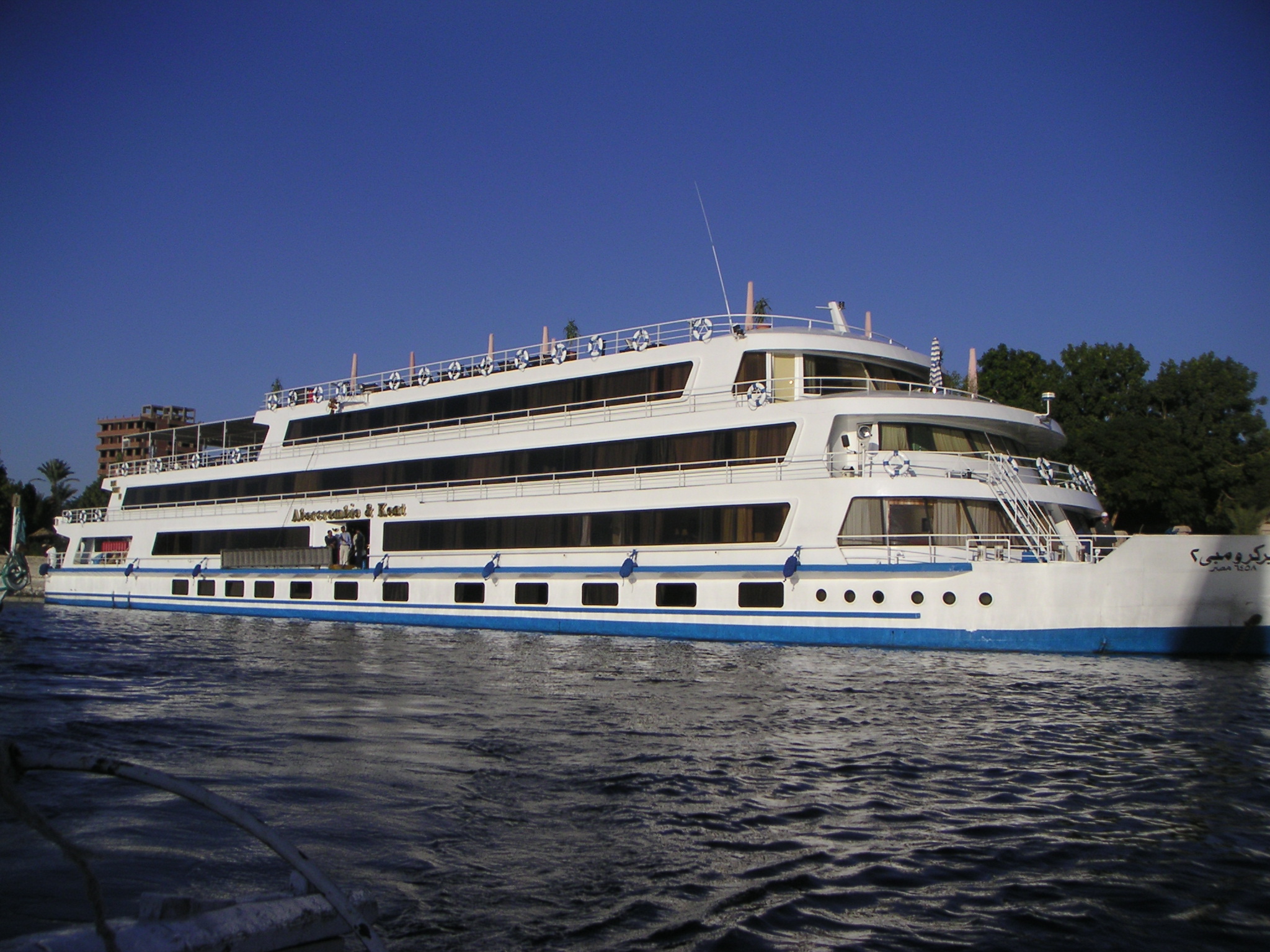
We organized a felucca trip from Aswan to Edfu for us and 6 other travelers. It was supposed to be three days and three nights. On the first day we had been sailing for no more than 20 minutes when the top boom snapped, forcing us to stop at the northern limits of Aswan town to have it repaired. Our captain said, "Half an hour." Maybe he meant until lunch because the repairs took all day. Five hours later, we set sail again. A couple of hours later, at the twilit end of sunset, the boom snapped again. This time the repair did only take half an hour. We sailed long into the night under a 3/4 moon illuminating the tall sail which arced above us to the few visible stars, all of us wearing everything in our bags and swaddled in blankets against the cold. We spend the night tied up to the river bank near a large pack of dogs that were almost hoarse from barking - almost but not hoarse. I think I slept about three hours, huddled under blankets next to my shivering husband. Somehow, it had managed to be a good day.
The next day was hazy, misty and cold. We played games, chatted, laughed, ridiculed one another and our countries, ate hot food, sipped hot tea with lots of sugar, drank beers that were too cold to hold, and sang loudly and badly. Our second night was much warmer, and the third day was clear and sunny. I was able to remove my goretex jacket. Around noon the meuzzin began their Friday call to prayer and our captain announced that we were in Edfu. A day early. There was much confusion. How did three days three nights become two nights and three half days of sailing??? My bladder took precedence over any discussions and I, with the three other women de-boated in search of a bathroom. We were immediately surrounded by a group of boys insisting that a bathroom was "Thees way" and pointing in about five different directions. We followed for a while and then decided to ditch them and try our luck asking at one of the nearby flotels. One of the young boys grabbed inappropriately at our Austrian "tea maiden" who turned and punched him hard. Meanwhile, our crowd of followers was growing: carriage drivers offered us rides; taxi drivers offered us rides; Ahwa owners offered us tea and coffee and soda; vendors tried to sell us postcards and kalabiyas and water pipes. It was an immediate, graceless transition from relaxation to tout-filled travel. I was not happy. I wanted to stay on the Nile, even with the cold eating away at my joints and making me feel like a 60 year old arthritic woman.
Declining offers of carriages and taxis, we walked through Edfu to the Temple of Horus, an immense structure most of which is still standing. Carvings or gods and pharoahs and wives and hieroglyphics. Immense columns. Graffiti in Greek. A colorful painting of a woman with a skirt of blue stars on a ceiling. A carving of Isis giving birth to Horus. And masses of tourists giving me dirty looks for elbowing my way through their groups which had completely blocked all passage through the temple.
Back to the felucca for bags and to try to explain to our captain that we were not paying the last 200 pounds we owed because the trip was 2.5 days, 2 nights instead of 3 days 3 nights. Much confusion. Much tension. Much ickiness. But it all sorted itself out... I think.
Then on to the bus station, with a following band of boys and carriage drivers telling us it was "Thees way" and pointing in about five different directions. Eventually we discovered we had to walk across the river to the main road where we would hopefully flag down a bus at the police checkpoint. When we arrived at the checkpoint 4 hot kilometers later and asked about a bus to Luxor we were told, "Maybe" by an officer with a face crinkled in doubt. Astonishingly, a bus appeared after only about 20 minutes - and we were allowed to board. There were even seats. And a movie without sound - but it was "Air Force One" so sound wasn't necessary. We stopped for half an hour in a cafe somewhere and caught the beginning of the Africa Nations Cup final: Egypt vs. Cote d'Ivoire. We left and the score was 0-0.
The bus dropped us off somewhere near Luxor, on a dark street in the countryside. Bilge Pump Bob immediately ran off to check the score: still 0-0. A taxi appeared, as they tend to do, and the driver with attendant crowd of men asked us for a ridiculous price, as they tend to do. He also claimed to have heard of the hotel we were aiming for, and then proceeded to stop to ask for directions at least three times. We were growing more and more irritable, wanting to be watching the game and/or showering and/or eating. We found the hotel which amazingly had enough rooms for all 8 of us, rooms that were clean and affordable. Most importantly, there was a TV in the lobby - and the score was still 0-0. The game went to penalty kicks when the Egypt goalkeeper stopped not one but two balls, winning the game for Egypt. Oh the honking celebrations! The flag waving! The shouts of Masr! The mad, sober revelry! I can only imagine that all of Cairo was turned into one hootin' tootin' parking lot.
We found a restaurant for dinner which served $1.25 roast chicken and $2.00 berbekio (bbq) which was delicious. Then we all collapsed into our warm beds with comfortable pillows realizing that despite the downs of the previous few days, we were still in the black.
We organized a felucca trip from Aswan to Edfu for us and 6 other travelers. It was supposed to be three days and three nights. On the first day we had been sailing for no more than 20 minutes when the top boom snapped, forcing us to stop at the northern limits of Aswan town to have it repaired. Our captain said, "Half an hour." Maybe he meant until lunch because the repairs took all day. Five hours later, we set sail again. A couple of hours later, at the twilit end of sunset, the boom snapped again. This time the repair did only take half an hour. We sailed long into the night under a 3/4 moon illuminating the tall sail which arced above us to the few visible stars, all of us wearing everything in our bags and swaddled in blankets against the cold. We spend the night tied up to the river bank near a large pack of dogs that were almost hoarse from barking - almost but not hoarse. I think I slept about three hours, huddled under blankets next to my shivering husband. Somehow, it had managed to be a good day.

The next day was hazy, misty and cold. We played games, chatted, laughed, ridiculed one another and our countries, ate hot food, sipped hot tea with lots of sugar, drank beers that were too cold to hold, and sang loudly and badly. Our second night was much warmer, and the third day was clear and sunny. I was able to remove my goretex jacket. Around noon the meuzzin began their Friday call to prayer and our captain announced that we were in Edfu. A day early. There was much confusion. How did three days three nights become two nights and three half days of sailing??? My bladder took precedence over any discussions and I, with the three other women de-boated in search of a bathroom. We were immediately surrounded by a group of boys insisting that a bathroom was "Thees way" and pointing in about five different directions. We followed for a while and then decided to ditch them and try our luck asking at one of the nearby flotels. One of the young boys grabbed inappropriately at our Austrian "tea maiden" who turned and punched him hard. Meanwhile, our crowd of followers was growing: carriage drivers offered us rides; taxi drivers offered us rides; Ahwa owners offered us tea and coffee and soda; vendors tried to sell us postcards and kalabiyas and water pipes. It was an immediate, graceless transition from relaxation to tout-filled travel. I was not happy. I wanted to stay on the Nile, even with the cold eating away at my joints and making me feel like a 60 year old arthritic woman.
Declining offers of carriages and taxis, we walked through Edfu to the Temple of Horus, an immense structure most of which is still standing. Carvings or gods and pharoahs and wives and hieroglyphics. Immense columns. Graffiti in Greek. A colorful painting of a woman with a skirt of blue stars on a ceiling. A carving of Isis giving birth to Horus. And masses of tourists giving me dirty looks for elbowing my way through their groups which had completely blocked all passage through the temple.
Back to the felucca for bags and to try to explain to our captain that we were not paying the last 200 pounds we owed because the trip was 2.5 days, 2 nights instead of 3 days 3 nights. Much confusion. Much tension. Much ickiness. But it all sorted itself out... I think.
Then on to the bus station, with a following band of boys and carriage drivers telling us it was "Thees way" and pointing in about five different directions. Eventually we discovered we had to walk across the river to the main road where we would hopefully flag down a bus at the police checkpoint. When we arrived at the checkpoint 4 hot kilometers later and asked about a bus to Luxor we were told, "Maybe" by an officer with a face crinkled in doubt. Astonishingly, a bus appeared after only about 20 minutes - and we were allowed to board. There were even seats. And a movie without sound - but it was "Air Force One" so sound wasn't necessary. We stopped for half an hour in a cafe somewhere and caught the beginning of the Africa Nations Cup final: Egypt vs. Cote d'Ivoire. We left and the score was 0-0.
The bus dropped us off somewhere near Luxor, on a dark street in the countryside. Bilge Pump Bob immediately ran off to check the score: still 0-0. A taxi appeared, as they tend to do, and the driver with attendant crowd of men asked us for a ridiculous price, as they tend to do. He also claimed to have heard of the hotel we were aiming for, and then proceeded to stop to ask for directions at least three times. We were growing more and more irritable, wanting to be watching the game and/or showering and/or eating. We found the hotel which amazingly had enough rooms for all 8 of us, rooms that were clean and affordable. Most importantly, there was a TV in the lobby - and the score was still 0-0. The game went to penalty kicks when the Egypt goalkeeper stopped not one but two balls, winning the game for Egypt. Oh the honking celebrations! The flag waving! The shouts of Masr! The mad, sober revelry! I can only imagine that all of Cairo was turned into one hootin' tootin' parking lot.
We found a restaurant for dinner which served $1.25 roast chicken and $2.00 berbekio (bbq) which was delicious. Then we all collapsed into our warm beds with comfortable pillows realizing that despite the downs of the previous few days, we were still in the black.
January 31, 2006
Not It
That last post was awful chipper, wasn't it? I'm still fairly chipper, though the freezing afternoon winds that plague this supposed-to-be-warm beach town are wearing me down. This is not the relaxing beach time I had in mind. I haven't dared do more than dabble my toes in the water while looking for brittle stars (one of which blew out of my hand, smacking our friend Tamr in the face before landing back in the water). And as for diving - forget it! I used to do cold, miserable dives for free; hell if I'm paying for them! Yes, we appear to have run smack-dab into winter. In January! The nerve!
I have spent a lot of time thinking about what it is that I'm doing, what I want to be doing, and what I think I should be doing - all while huddled in our room under blankets looking across the choppy waters at Saudi Arabia. Rather than traveling to see/experience things, I'm traveling to find somewhere else to live (for a while). I keep forgetting this and going off to see the sites which I just can't enjoy. See previous post about Ethiopia for more details. Last time I traveled, I found lots of places that I could have imagined staying (for a while, anyway). This trip has been a series of, Not Heres. And while ruling things out is valuable, it doesn't actually get me any closer to figuring out where I want to be. It's frustrating. And cold. Did I mention that it's cold in the northern hemisphere in January? Well, it is. And the $0.50 falafels, while delicious, are small consolation.
I have spent a lot of time thinking about what it is that I'm doing, what I want to be doing, and what I think I should be doing - all while huddled in our room under blankets looking across the choppy waters at Saudi Arabia. Rather than traveling to see/experience things, I'm traveling to find somewhere else to live (for a while). I keep forgetting this and going off to see the sites which I just can't enjoy. See previous post about Ethiopia for more details. Last time I traveled, I found lots of places that I could have imagined staying (for a while, anyway). This trip has been a series of, Not Heres. And while ruling things out is valuable, it doesn't actually get me any closer to figuring out where I want to be. It's frustrating. And cold. Did I mention that it's cold in the northern hemisphere in January? Well, it is. And the $0.50 falafels, while delicious, are small consolation.
January 26, 2006
It's Different Here
Egypt is different to Ethiopia. For starters, we're having fun in Egypt - and we're eating. Today we mailed a package; it took about 20 minutes. The post office employee not only gave us a box and taped it up for us, but also gave Z a cheese sandwich. In Addis, it took us over 45 minutes to mail a package to Aus, time we spent wandering between window 2 who sent us to window 15 who sent us back to window 2 who insisted that we go to window 15 who told us that window 2 was the only place to help us. It was not fun. Cairo is fun. When we walk down the streets we hear, Welcome to Cairo! rather than, Give me pen. And they have the pyramids here. Them's big piles of rocks; much more impressive than big rocks.
Last night we went to the Morocco vs. Egypt match of the Africa Nations Cup. There was at least one cop in riot gear for every five people. Another difference between Ethiopia and Egypt: there are so many more police here. Maybe that's because there are things worth stealing in Egypt.
Z and I are discovering just how much we don't like the tourist sites. And how much we do like shops cluttered with dusty "antiques", even if they apply dust every day just to make the stuff look old. We travel well together; it's a wonderful thing. We're able to realize this and appreciate it now that we're in Egypt. Travel is fun again.
I am happy. Excited even. Renewed and rejeuvenated. By Cairo! Who woulda thunk? Other travelers that have been to Cairo have tried to minimize their time here saying it's too polluted and crazy. Polluted it certainly is; crazy too. But it's also lively and full of friendly strangers who do things like buy us lunch just because we're sitting at the next table over and are foreign.
Strikes against Cairo include the excessive usage of the automobile horn. Right now, in the background, it's a veritable symphonie de honk. The streets are madness; crossing them requires faith and fast footwork. On our first day in Cairo, we stood at the crosswalk staring into the mass of cars and wondering how we would ever get cross. As we stood there, a man passed us riding a bicycle and deftly wove his way through the traffic balancing an immense tray of pita bread on his head.
Tomorrow, we're going to Dahab where there will be less honking and hopefully less black-booger-inducing smog. We plan to relax for as long as it takes us to relax. Then we'll see some sights down on the Nile and then... Well, we're not sure what will we'll do after that. But then again, we're never really sure what's going to happen next. Especially in Egypt.
Last night we went to the Morocco vs. Egypt match of the Africa Nations Cup. There was at least one cop in riot gear for every five people. Another difference between Ethiopia and Egypt: there are so many more police here. Maybe that's because there are things worth stealing in Egypt.
Z and I are discovering just how much we don't like the tourist sites. And how much we do like shops cluttered with dusty "antiques", even if they apply dust every day just to make the stuff look old. We travel well together; it's a wonderful thing. We're able to realize this and appreciate it now that we're in Egypt. Travel is fun again.
I am happy. Excited even. Renewed and rejeuvenated. By Cairo! Who woulda thunk? Other travelers that have been to Cairo have tried to minimize their time here saying it's too polluted and crazy. Polluted it certainly is; crazy too. But it's also lively and full of friendly strangers who do things like buy us lunch just because we're sitting at the next table over and are foreign.
Strikes against Cairo include the excessive usage of the automobile horn. Right now, in the background, it's a veritable symphonie de honk. The streets are madness; crossing them requires faith and fast footwork. On our first day in Cairo, we stood at the crosswalk staring into the mass of cars and wondering how we would ever get cross. As we stood there, a man passed us riding a bicycle and deftly wove his way through the traffic balancing an immense tray of pita bread on his head.
Tomorrow, we're going to Dahab where there will be less honking and hopefully less black-booger-inducing smog. We plan to relax for as long as it takes us to relax. Then we'll see some sights down on the Nile and then... Well, we're not sure what will we'll do after that. But then again, we're never really sure what's going to happen next. Especially in Egypt.
January 23, 2006
Pretty as a Picture
We have traveled a long, long way. I realize that now, looking at these pictures. We've seen some really beautiful things, and collected a lot of dust and mud to go along with the stories. The photos go way back to a certain monkey-eating incident in Tanzania. They chronicle our times in Uganda and Ethiopia and even the beginning of our time here in Cairo. Happy vicarious traveling!
January 19, 2006
My barrel is full
This wonderful phrase is the German equivalent of, I've had it up to here. It's a colorful way to describe the lack of patience I've had of late. I think that three months travel through Africa is the equivalent of a year in Asia. So, I'm tired. We are in the land of fast internets now (Cairo) and so will try to keep this blog more updated than it's been recently, thereby stemming the flood of complaints. Without further ado...
Ethiopia. From the air, I can see that the horizon is rimmed by a thick layer of brown. Not smog: dust. The terrain is a series of brown plateaus carved by deep ravines. At the bottom flow wide rivers of dry, grey stones. It is hard to imagine that there has ever been or ever will be enough water to cut such deep gorges. Like the air, the ground is also dusty. Most of the fields lie fallow, a collection of dry stalks and rocks. Most of the rivers are completely dry. In one riverbed, I see women washing clothing in a puddle - all the water that remains. The rains don't arrive until May and everyone is predicting massive droughts for the Horn and East Africa. We take short showers every other day.
The roads are impressive feats of engineering carved up and down gorges the size of the grand canyon. The buses are less impressive being about 40 years old and full of dust. On the 11-hour trip from Gonder to Shire, I spent much of the time with my sarong wrapped around my mouth and nose to facilitate breathing. It was like a mini-burning-man dust storm inside the bus. In addition to dust, the air is filled with the sound of Ethiopian music played on cassettes that have been baked on the dashboard for months. Z and I joke that the songs are hits by such memorable groups as The Strangling Cats, The Gurgling Dervishes and The Drowning Eunechs. A man seated behind us complains loudly and asks the conductor to turn off the music (even though all was spoken in Amharic, the meaning was clear). The bus goes silent - for at least five minutes. And then the music starts again. We suffer on through a land with very little green - what green exists is a dusty shade of olive; there's no freshness. It would be a hard land to live in; I now understand what people mean when they say that Africa is a mess.
There are so many poor people here and so many of them are disabled by age or polio or elaphantitus or other disfiguring diseases. Many are amputees. All are beggars. We make it a habit to not give money to children or people who look like they could work (not that there are any jobs to be had), saving our coins instead for the old and disabled. One older man stops us on the cobbled street of Lalibela to ask for change. He sports a dusty grey turban and is leaning heavily on a staff. Z digs into his pocket and gives him some change - not much, but something. The man looks at the coins in his palm, makes a face, shakes his finger at Z and says something at us in Amharic. The meaning is clear: somehow we have insulted him by the smallness of our donation. Outraged, Z takes the money back and we walk off thinking, Don't beg if you don't need whatever you can get. This is not the only time this happens. But it is balanced by moments where people seem grateful. Also in Lalibela, we see a woman in front of us crawling because she has no feet. Without her asking, we give her some money. Her face lights up with joy and immense gratitude. She seems so happy; we gave so little. I appreciate her for combatting my growing cynicism.
On an island in Lake Tana near Bahar Dar we walk up a rocky trail to a monastery. The round church in the compound has dark brown dirt walls flecked with hay; they seem velvety. The center of the roof is topped with a cross and bells that tinkle delicately in the breeze. Three of us pay the guard to go in. The doors are solid wood, tall - the kind that fold in half and then push open. As they open, sunlight hits the walls of the inner sanctuary which are painted with brilliant colors: saints and angels and more saints with afros in purples, greens, yellow, reds, oranges and blues. The colors have the vivacity of central America. We recognize a couple of figures: here's the saint who was a cannibal; there's the saint whose leg fell of and then flew up to heaven. It's brilliant and beautiful and completely unexpected.
We reach Lalibela as our barrels begin to overflow. It's a poor town on a steep hill. The nicest house we see doesn't have glass in its windows. And the churches! Carved from solid rock! Some are still partly attached to the rock around them; some have been excised and stand as monoliths. The walls are pocked by chisel marks; there are columns and arches and complicated drainage systems and one tunnel that we walk through that is completely pitch black. I walk with one hand on the ceiling, one hand on the wall. We emerge into the light tingling with the thrill of it. Walking through yet another giant monument to God, I am astounded as the lengths to which people will go because of faith.
I am also astounded as to the lengths we will go to avoid talking to people. Most are touts and children selling things, though I'm sure we also spurn some well-meaning folk. On one memorable walk, when asked where he is from, Z replies, "Venus." The children seem puzzled for a moment and ask, pointing at the sky, "Venus?" Z assures them that yes, they understand him correctly; he is from Venus. "Did you come by rocket?" they ask. "No," Z replies and then pantomimes flying and climbing a rope. I am in hysterics. The children are also laughing. They they ask Z what he does. He explains that he's a vampire (a word they instantly understand), which is why he cannot buy any of the leather or silver crosses that they are hawking. At another time, I pretend that I don't speak English and discover just how hard it is to not react to people when they are talking to you. One group of men lounging by a wall in Aksum asks us if we need a guide. When we say no thank you, they ask, "Would you like to be heckled?" We laugh and walk on.
So for all the moments of exasperation and the lack of culinary delight, there have also been funny moments and beautiful things to see. The churches of Lalibela; the castles of Gonder. This country is certainly worth visiting if you have a two week holiday. Just remember to bring vitamins.
Ethiopia. From the air, I can see that the horizon is rimmed by a thick layer of brown. Not smog: dust. The terrain is a series of brown plateaus carved by deep ravines. At the bottom flow wide rivers of dry, grey stones. It is hard to imagine that there has ever been or ever will be enough water to cut such deep gorges. Like the air, the ground is also dusty. Most of the fields lie fallow, a collection of dry stalks and rocks. Most of the rivers are completely dry. In one riverbed, I see women washing clothing in a puddle - all the water that remains. The rains don't arrive until May and everyone is predicting massive droughts for the Horn and East Africa. We take short showers every other day.
The roads are impressive feats of engineering carved up and down gorges the size of the grand canyon. The buses are less impressive being about 40 years old and full of dust. On the 11-hour trip from Gonder to Shire, I spent much of the time with my sarong wrapped around my mouth and nose to facilitate breathing. It was like a mini-burning-man dust storm inside the bus. In addition to dust, the air is filled with the sound of Ethiopian music played on cassettes that have been baked on the dashboard for months. Z and I joke that the songs are hits by such memorable groups as The Strangling Cats, The Gurgling Dervishes and The Drowning Eunechs. A man seated behind us complains loudly and asks the conductor to turn off the music (even though all was spoken in Amharic, the meaning was clear). The bus goes silent - for at least five minutes. And then the music starts again. We suffer on through a land with very little green - what green exists is a dusty shade of olive; there's no freshness. It would be a hard land to live in; I now understand what people mean when they say that Africa is a mess.
There are so many poor people here and so many of them are disabled by age or polio or elaphantitus or other disfiguring diseases. Many are amputees. All are beggars. We make it a habit to not give money to children or people who look like they could work (not that there are any jobs to be had), saving our coins instead for the old and disabled. One older man stops us on the cobbled street of Lalibela to ask for change. He sports a dusty grey turban and is leaning heavily on a staff. Z digs into his pocket and gives him some change - not much, but something. The man looks at the coins in his palm, makes a face, shakes his finger at Z and says something at us in Amharic. The meaning is clear: somehow we have insulted him by the smallness of our donation. Outraged, Z takes the money back and we walk off thinking, Don't beg if you don't need whatever you can get. This is not the only time this happens. But it is balanced by moments where people seem grateful. Also in Lalibela, we see a woman in front of us crawling because she has no feet. Without her asking, we give her some money. Her face lights up with joy and immense gratitude. She seems so happy; we gave so little. I appreciate her for combatting my growing cynicism.
On an island in Lake Tana near Bahar Dar we walk up a rocky trail to a monastery. The round church in the compound has dark brown dirt walls flecked with hay; they seem velvety. The center of the roof is topped with a cross and bells that tinkle delicately in the breeze. Three of us pay the guard to go in. The doors are solid wood, tall - the kind that fold in half and then push open. As they open, sunlight hits the walls of the inner sanctuary which are painted with brilliant colors: saints and angels and more saints with afros in purples, greens, yellow, reds, oranges and blues. The colors have the vivacity of central America. We recognize a couple of figures: here's the saint who was a cannibal; there's the saint whose leg fell of and then flew up to heaven. It's brilliant and beautiful and completely unexpected.
We reach Lalibela as our barrels begin to overflow. It's a poor town on a steep hill. The nicest house we see doesn't have glass in its windows. And the churches! Carved from solid rock! Some are still partly attached to the rock around them; some have been excised and stand as monoliths. The walls are pocked by chisel marks; there are columns and arches and complicated drainage systems and one tunnel that we walk through that is completely pitch black. I walk with one hand on the ceiling, one hand on the wall. We emerge into the light tingling with the thrill of it. Walking through yet another giant monument to God, I am astounded as the lengths to which people will go because of faith.
I am also astounded as to the lengths we will go to avoid talking to people. Most are touts and children selling things, though I'm sure we also spurn some well-meaning folk. On one memorable walk, when asked where he is from, Z replies, "Venus." The children seem puzzled for a moment and ask, pointing at the sky, "Venus?" Z assures them that yes, they understand him correctly; he is from Venus. "Did you come by rocket?" they ask. "No," Z replies and then pantomimes flying and climbing a rope. I am in hysterics. The children are also laughing. They they ask Z what he does. He explains that he's a vampire (a word they instantly understand), which is why he cannot buy any of the leather or silver crosses that they are hawking. At another time, I pretend that I don't speak English and discover just how hard it is to not react to people when they are talking to you. One group of men lounging by a wall in Aksum asks us if we need a guide. When we say no thank you, they ask, "Would you like to be heckled?" We laugh and walk on.
So for all the moments of exasperation and the lack of culinary delight, there have also been funny moments and beautiful things to see. The churches of Lalibela; the castles of Gonder. This country is certainly worth visiting if you have a two week holiday. Just remember to bring vitamins.
December 21, 2005
update in five movements
1. While hiking in Arusha National Park, Tanzania our guide told us what to do if a buffalo charges: lie down. That way their horns can't get underneath you. This advice assumes you would rather be trampled to death than gored to death. Tough choice, that. While hiking in Murchison National Park, Uganda we had the incredible good fortune of coming across a family of about 20 chimpanzees. Some were in the trees, others on the ground about 10m away through fairly thick bush. Squatting next to the guide, he pointed at a male on the ground and whispered, "That one is rough." "Rough?" I asked. "Yes - mean." I asked what one should do if faced with an agressive chimp and was assured that with a group of our size (Z and our guide had encountered a European couple and their guide), a chimp wouldn't act agressively. "But what if you're alone? What do you do if you're alone?" I pressed. The guides looked at me like I was crazy and said simply, "Don't."
2. Sleep is not treated with the same respect here as in other parts of the world. For example, it is perfectly acceptable to honk your horn repeatedly at 2:00am. Holding conversations at full volume in hotel courtyards at 4:30am is just fine. Radios at 3:15am? No problem! On the night bus from Mbale, Uganda to Nairobi, Kenya I learned that shrieking with laughter at midnight on a darkened bus is also perfectly acceptable. I did manage to fall asleep eventually only to be awoken by the bus bumping and swaying as it progressed down what was obviously a windy dirt road. I stuck my head into the aisle and peered out the front windows. I discovered that we were actually on a straight road - a paved, straight road. It had apparently last been resurfaced in 1936. Our bus was navigating an impressive slalom course around the axle-breaking potholes. I watched until I realized that I was gripping the arm rest tightly and tensing my jaw everytime we swayed precariously. I decided it was better to put my eye mask back on and pretend that we were on a mountain road.
3. You have probably by now read about the monkey-eating chronicles. Last night we went to Carnivore, a restaurant that would strike horror into the heart of every vegetarian. I learned that I don't like crocodile - fish should be fishy and meat should be meaty. Fishy meat is not a good thing. Camel is unsurprisingly chewy and remarkably flavorless. Ostrich meatballs are quite good. Lamb still remains one of my favorite carnivoric indulgences.
In other culinary news, I have developped a taste for matooke, one of the staples of the Ugandan diet. It's cooked green banana mush, usually served with beans and cabbage. This may explain the lack of East African restaurants in America. But really, it's not that bad.
4. In Sipi, Uganda we had dinner at the restaurant in town which was also the pub. Picture a small room with ancient, dusty chairs arranged around a low formica table and unpainted concrete walls with ripped beer ads and faded religious calendars tacked up at strange angles. Across the doorway swung a "beaded" curtain made from bent bottle caps and blue twine. It was here that we got into a discussion with three men about AIDS. One man, the youngest at about 20, asked if it's true that condoms cause cancer. We emphatically denied this vicious rumor, drawing all the authority we could from the fact that I'm a scientist and American. Hopefully the young man was convinced and will tell his friends.
That evening was the first time in two months that I have felt comfortable, welcomed and at ease with locals. The conversation was motivated by mutual interest, not money. It was fantastic. It made me aware, however, of the things that I miss. I'm looking forward to finding a home somewhere - to feeling at home somewhere.
5. In three hours we fly to Addis Abbaba, Ethiopia. I think it's going to be very different. At least I know that I like Ethiopian food.
2. Sleep is not treated with the same respect here as in other parts of the world. For example, it is perfectly acceptable to honk your horn repeatedly at 2:00am. Holding conversations at full volume in hotel courtyards at 4:30am is just fine. Radios at 3:15am? No problem! On the night bus from Mbale, Uganda to Nairobi, Kenya I learned that shrieking with laughter at midnight on a darkened bus is also perfectly acceptable. I did manage to fall asleep eventually only to be awoken by the bus bumping and swaying as it progressed down what was obviously a windy dirt road. I stuck my head into the aisle and peered out the front windows. I discovered that we were actually on a straight road - a paved, straight road. It had apparently last been resurfaced in 1936. Our bus was navigating an impressive slalom course around the axle-breaking potholes. I watched until I realized that I was gripping the arm rest tightly and tensing my jaw everytime we swayed precariously. I decided it was better to put my eye mask back on and pretend that we were on a mountain road.
3. You have probably by now read about the monkey-eating chronicles. Last night we went to Carnivore, a restaurant that would strike horror into the heart of every vegetarian. I learned that I don't like crocodile - fish should be fishy and meat should be meaty. Fishy meat is not a good thing. Camel is unsurprisingly chewy and remarkably flavorless. Ostrich meatballs are quite good. Lamb still remains one of my favorite carnivoric indulgences.
In other culinary news, I have developped a taste for matooke, one of the staples of the Ugandan diet. It's cooked green banana mush, usually served with beans and cabbage. This may explain the lack of East African restaurants in America. But really, it's not that bad.
4. In Sipi, Uganda we had dinner at the restaurant in town which was also the pub. Picture a small room with ancient, dusty chairs arranged around a low formica table and unpainted concrete walls with ripped beer ads and faded religious calendars tacked up at strange angles. Across the doorway swung a "beaded" curtain made from bent bottle caps and blue twine. It was here that we got into a discussion with three men about AIDS. One man, the youngest at about 20, asked if it's true that condoms cause cancer. We emphatically denied this vicious rumor, drawing all the authority we could from the fact that I'm a scientist and American. Hopefully the young man was convinced and will tell his friends.
That evening was the first time in two months that I have felt comfortable, welcomed and at ease with locals. The conversation was motivated by mutual interest, not money. It was fantastic. It made me aware, however, of the things that I miss. I'm looking forward to finding a home somewhere - to feeling at home somewhere.
5. In three hours we fly to Addis Abbaba, Ethiopia. I think it's going to be very different. At least I know that I like Ethiopian food.
December 08, 2005
Bombs
No, no, no. Not that kind of bomb! I'm talking about guava bombs. And believe me, when a monkey or hornbill drops a guava from a tall tree onto a tin roof, the effect is as shocking as a bomb - though perhaps not as destructive, unless you're the guava.
We rented a lovely cabin with a nice tin roof under a tall guava tree by the shores of a crater lake near Fort Portal, Uganda. There were lots of monkeys and lots of hornbills, and therefore lots of guava bombs. The ones in the middle of the night were the worst. There's nothing quite like waking up suddenly to what sounds like a shotgun being discharged right above your bed!
I spent a morning lying in a hammock watching red colobus monkeys in the trees across the lake while Z and our Canadian travel companion, Frances, went for a walk. All was still until a tree rustled violently and a small brown body appeared in mid-air, hurtling from one tree to another. In this fashion, the monkeys would cross gaps of about 30m. On my side of the lake, a curious black & white colobus descended low into a nearby tree to stare at me with its grumpy-old-man face. Behind me, the crash of guavas onto tin let me know that hornbills were about. Their wingbeats sounded as loud as small helicopters. With so much noisy wildlife (including toads that at night sang a chorus of belches!), the lake wasn't exactly peaceful - but it was relaxing.
From Lake Nkurubu, we moved on to Lake Bunyoni by bus. I fared better than Z, actually getting a seat - but one so cramped that several of my toes fell asleep. In some places, the road was under construction which meant that we detoured onto side roads - really more like tracks parallel to and below the real road. I caught a glimpse of the first detour through the crush of people around my seat and was dismayed: thick, black mud, a deep and wide puddle, and tire tracks that seemed to slide all over the place. "We're going to get stuck for sure," I thought. Seeing the look on my face, a woman seated near me (by seated, I mean perched on the railing above the stairwell) turned to reassure me saying, "And now we pray." Uh, thanks. Feeling much better now! We didn't in fact get stuck, though we did slide all over the place and I did pray.
The view from the bus grew steadily more beautiful as the hills gathered into highlands and mountains and the bus emptied out and my toes woke up. We got to Kabale under dark storm clouds which highlighted the contrast between sky and bright green hills. From there, we took a taxi to Lake Bunyoni: a stretch of silvery grey water between steep green hills covered with a patchwork of green terraced fields that reached all the way to the shores of the lake. It was beautiful and peaceful and surprisingly cold. On our second night at the lake, a storm rolled through. The lightening lit up lake, clouds, trees and grass with a violet light. I sat outside and listened to the thunder rumble from one side of the sky to the other and back. I once counted it rumble on uninterupted for two minutes. I crawled into bed once the rain pounding on the tin roof drowned out the thunder.
From bunyoni we took a spectaculor bus ride to Kisoro, a town nestled at the foot of the Virunga volcanos on the border with Rwanda and the Congo. The volcanos are immense, rising 10,000ft in perfect triangular form - exactly the shape that children draw mountains to be. Their peaks were wreathed in swirling clouds and their slopes densely forested. Staring into the Congo and Rwanda was a strange feeling - there, right over there, are two countries that are kinda sketchy. And here we are, in Uganda, feeling safe and happy. I guess I'm still a stranger to land borders.
Once again, our room in Kisoro had a tin roof, though it wasn't guava bombs that woke me in the morning but crow bombs. Which is to say crows - big crows, landing full force on the roof and jumping around. Not quite as loud as guava bombs, they nonetheless woke me up!
We had come to Kisoro in search of pythons which live on the shores of nearby Lake Mutanda. We walked with guide Joseph across hills and through villages to the lake, the air echoing with the sound of children yelling, "Muzungu, how are yooooooooooouuu?" (Muzungu means, approximately, white man.) I had imagined us taking a dugout canoe trip around the island looking for pythons that were curled in trees and safely distant across the water. Once again, however, Africa delivered the unexpected. We did take a dugout canoe across to the island, but they we got out of the canoe and walked. In search of snakes. Big snakes. Clad in sandals, we pushed our way through thickets of beans and corn and bananas and rushes, staring into the reeds for python. This struck me as absurdly stupid. I mean, who goes looking for snakes in thickets? (Answer: M&Z - duh!) The thought of surprising a snake made my toes curl protectively towards my body, as if that would put enough distance between me and snake to avoid getting bitten. Hah! For better or worse, we didn't see any snakes. Not surprisingly, I was disappointed.
The night after the hike was filled with another storm. The thunder was so loud that I couldn't help but flinch when it crashed directly overhead, sounding like a semi truck trailer full of metal filing cabinets rolling around on the roof.
After a crappy bus ride on a broken seat, we find ourselves back in Kampala. The trip through southwestern Uganda was really great. I felt happy to be traveling; the work to get somewhere was rewarded by the places at which we arrived. Not a lot of Africa has been like that. Kisoro was just so beautiful - and not overrun with overland trucks full of drunken yahoos. A lot of our experience here has been tempered by the presence of these large groups. I met an Austalian from one truck at Lake Bunyoni who asked me which company I was traveling from. When I told him that my husband (!still not used to that!) and I were traveling independently he was astonished by our bravery.
"You have a jeep, then?" he enquired.
"Nope."
"Well, how do you get around?"
"We take the bus."
"Bus?"
"Yeah, the public bus."
"You do???" Astonishment. "But how?"
I tried to limit the sarcasm in my response, which was something like, "You get on the bus. Someone asks you for money. You give that person money and they give you a ticket. You get off at your stop." I mean, what's the bravery in that???
Sigh. We're going to rest up here for a few days, stuff ourselves with Indian food and get over the colds we both have before pushing on to Murchison Falls. From there the plan is still to make our way overland to Nairobi and hop on a flight to Ethiopia. I'm looking forward to seeing Ethiopia. It should be really different. I'm also looking forward to going white water rafing on the source of the Nile. And then seeing the other end of that mighty river in Egypt. Even with travel being different this time - not so much fun, I suppose - I certainly can't complain. I mean, I'm in Africa!
We rented a lovely cabin with a nice tin roof under a tall guava tree by the shores of a crater lake near Fort Portal, Uganda. There were lots of monkeys and lots of hornbills, and therefore lots of guava bombs. The ones in the middle of the night were the worst. There's nothing quite like waking up suddenly to what sounds like a shotgun being discharged right above your bed!
I spent a morning lying in a hammock watching red colobus monkeys in the trees across the lake while Z and our Canadian travel companion, Frances, went for a walk. All was still until a tree rustled violently and a small brown body appeared in mid-air, hurtling from one tree to another. In this fashion, the monkeys would cross gaps of about 30m. On my side of the lake, a curious black & white colobus descended low into a nearby tree to stare at me with its grumpy-old-man face. Behind me, the crash of guavas onto tin let me know that hornbills were about. Their wingbeats sounded as loud as small helicopters. With so much noisy wildlife (including toads that at night sang a chorus of belches!), the lake wasn't exactly peaceful - but it was relaxing.
From Lake Nkurubu, we moved on to Lake Bunyoni by bus. I fared better than Z, actually getting a seat - but one so cramped that several of my toes fell asleep. In some places, the road was under construction which meant that we detoured onto side roads - really more like tracks parallel to and below the real road. I caught a glimpse of the first detour through the crush of people around my seat and was dismayed: thick, black mud, a deep and wide puddle, and tire tracks that seemed to slide all over the place. "We're going to get stuck for sure," I thought. Seeing the look on my face, a woman seated near me (by seated, I mean perched on the railing above the stairwell) turned to reassure me saying, "And now we pray." Uh, thanks. Feeling much better now! We didn't in fact get stuck, though we did slide all over the place and I did pray.
The view from the bus grew steadily more beautiful as the hills gathered into highlands and mountains and the bus emptied out and my toes woke up. We got to Kabale under dark storm clouds which highlighted the contrast between sky and bright green hills. From there, we took a taxi to Lake Bunyoni: a stretch of silvery grey water between steep green hills covered with a patchwork of green terraced fields that reached all the way to the shores of the lake. It was beautiful and peaceful and surprisingly cold. On our second night at the lake, a storm rolled through. The lightening lit up lake, clouds, trees and grass with a violet light. I sat outside and listened to the thunder rumble from one side of the sky to the other and back. I once counted it rumble on uninterupted for two minutes. I crawled into bed once the rain pounding on the tin roof drowned out the thunder.
From bunyoni we took a spectaculor bus ride to Kisoro, a town nestled at the foot of the Virunga volcanos on the border with Rwanda and the Congo. The volcanos are immense, rising 10,000ft in perfect triangular form - exactly the shape that children draw mountains to be. Their peaks were wreathed in swirling clouds and their slopes densely forested. Staring into the Congo and Rwanda was a strange feeling - there, right over there, are two countries that are kinda sketchy. And here we are, in Uganda, feeling safe and happy. I guess I'm still a stranger to land borders.
Once again, our room in Kisoro had a tin roof, though it wasn't guava bombs that woke me in the morning but crow bombs. Which is to say crows - big crows, landing full force on the roof and jumping around. Not quite as loud as guava bombs, they nonetheless woke me up!
We had come to Kisoro in search of pythons which live on the shores of nearby Lake Mutanda. We walked with guide Joseph across hills and through villages to the lake, the air echoing with the sound of children yelling, "Muzungu, how are yooooooooooouuu?" (Muzungu means, approximately, white man.) I had imagined us taking a dugout canoe trip around the island looking for pythons that were curled in trees and safely distant across the water. Once again, however, Africa delivered the unexpected. We did take a dugout canoe across to the island, but they we got out of the canoe and walked. In search of snakes. Big snakes. Clad in sandals, we pushed our way through thickets of beans and corn and bananas and rushes, staring into the reeds for python. This struck me as absurdly stupid. I mean, who goes looking for snakes in thickets? (Answer: M&Z - duh!) The thought of surprising a snake made my toes curl protectively towards my body, as if that would put enough distance between me and snake to avoid getting bitten. Hah! For better or worse, we didn't see any snakes. Not surprisingly, I was disappointed.
The night after the hike was filled with another storm. The thunder was so loud that I couldn't help but flinch when it crashed directly overhead, sounding like a semi truck trailer full of metal filing cabinets rolling around on the roof.
After a crappy bus ride on a broken seat, we find ourselves back in Kampala. The trip through southwestern Uganda was really great. I felt happy to be traveling; the work to get somewhere was rewarded by the places at which we arrived. Not a lot of Africa has been like that. Kisoro was just so beautiful - and not overrun with overland trucks full of drunken yahoos. A lot of our experience here has been tempered by the presence of these large groups. I met an Austalian from one truck at Lake Bunyoni who asked me which company I was traveling from. When I told him that my husband (!still not used to that!) and I were traveling independently he was astonished by our bravery.
"You have a jeep, then?" he enquired.
"Nope."
"Well, how do you get around?"
"We take the bus."
"Bus?"
"Yeah, the public bus."
"You do???" Astonishment. "But how?"
I tried to limit the sarcasm in my response, which was something like, "You get on the bus. Someone asks you for money. You give that person money and they give you a ticket. You get off at your stop." I mean, what's the bravery in that???
Sigh. We're going to rest up here for a few days, stuff ourselves with Indian food and get over the colds we both have before pushing on to Murchison Falls. From there the plan is still to make our way overland to Nairobi and hop on a flight to Ethiopia. I'm looking forward to seeing Ethiopia. It should be really different. I'm also looking forward to going white water rafing on the source of the Nile. And then seeing the other end of that mighty river in Egypt. Even with travel being different this time - not so much fun, I suppose - I certainly can't complain. I mean, I'm in Africa!
November 28, 2005
Funnies
We are in Kampala, Uganda. We are safe and well and like this city a helluva lot more than Dar es Slum. There are lots of funny signs and ads here, including:
"OMO: Removes even hidden stains."
(If a stain is hidden, is it still a stain?)
"When you have a choice, Sleeping Baby is the right choice."
(I think all parents will agree with this!)
"Real fruit juice taste."
(mmm...)
"Need a lover? 4356678"
"Need a wife? 4356678"
"Need a husband? 4356678"
Now that's called one stop shopping!!!!
"OMO: Removes even hidden stains."
(If a stain is hidden, is it still a stain?)
"When you have a choice, Sleeping Baby is the right choice."
(I think all parents will agree with this!)
"Real fruit juice taste."
(mmm...)
"Need a lover? 4356678"
"Need a wife? 4356678"
"Need a husband? 4356678"
Now that's called one stop shopping!!!!
November 25, 2005
"plans"
I think it was just yesterday that I blogged, though with the days feeling as long as weeks, it could have been last year. It's funny how time slows down while one is traveling and yet still things can manage to change so fast - like our travel plans.
We looked into going south and discovered it expensive and not that appealing. After much indecisiveness and a trip out of town to a decent bookstore (where we sold a fellow traveler our Tanzania guide - turns out there aren't any to be found in Tanzania), and some wandering in and out of travel agents, and some reading and at least one sleepless night we actually have a plan -- one that involves a plane ticket. Yep, it's a real plan this time! On Saturday, we're flying to Kampala, Uganda (seemed worth the extra $$$ to avoid a 25 hour bus ride, the day-time part of which crosses country we've already seen - twice). Aftr Ugand we intend to make our way overland across Kenya to Nairobi where we'll hop on a flight to Addis Abbaba (Ethiopia). Perhaps we'll even be in Lalibela (home of immense rock-hewn churches and the ancient Christian Coptic sect) for Christmas. The thought of onward movement has me feeling fresh. I found that the lack of plan - then lack of concrete plan, made me a little crazy.
My dear friend Kelly sent me some wonderful advice about the stage of travel which goes something like:
Stage 1. Wheee! Everything's new and exciting and wonderful. Oh my god! Did you see that lion???
Stage 2. Huh? Why did we leave our comfortable bed with the clean sheets and the shower with the water in it and the car and the paved roads and the recognizable food to come to some hot, mosquito-ridden place and take Larium???
Stage 3. In the groove - enjoying travel. Things going as smoothly as can be expected. Able to laugh when confronted with absurdly frustrating circumstances.
Stage 4. Winding the trip down and preparing to come home.
I can say that after spending a certain amount of time in stage 1 and what seemed like a long time in stage 2, I think I'm working my way into stage 3. I'm quicker to laugh at the things that go wrong (exhibit A: the computer system that issues AMEX traveler's checks in Tanzania and Kenya is down. For a month!) and I think I've figured out how to cross the street. Here we are in Tanzania's main city and there are no stop signs, no yield signs and a snarl of honking cars going every which way at each corner. The few traffic lights I've seen have been red but that hasn't appeared to dissuade the cars from driving on anyway. Needless to say, crossing the street is an art - and I'm certainly getting better at it. Signs are looking good that things are getting smoother.
Happy Thanksgiving to all the Americans! Perhaps we'll have (more) Indian food???
We looked into going south and discovered it expensive and not that appealing. After much indecisiveness and a trip out of town to a decent bookstore (where we sold a fellow traveler our Tanzania guide - turns out there aren't any to be found in Tanzania), and some wandering in and out of travel agents, and some reading and at least one sleepless night we actually have a plan -- one that involves a plane ticket. Yep, it's a real plan this time! On Saturday, we're flying to Kampala, Uganda (seemed worth the extra $$$ to avoid a 25 hour bus ride, the day-time part of which crosses country we've already seen - twice). Aftr Ugand we intend to make our way overland across Kenya to Nairobi where we'll hop on a flight to Addis Abbaba (Ethiopia). Perhaps we'll even be in Lalibela (home of immense rock-hewn churches and the ancient Christian Coptic sect) for Christmas. The thought of onward movement has me feeling fresh. I found that the lack of plan - then lack of concrete plan, made me a little crazy.
My dear friend Kelly sent me some wonderful advice about the stage of travel which goes something like:
Stage 1. Wheee! Everything's new and exciting and wonderful. Oh my god! Did you see that lion???
Stage 2. Huh? Why did we leave our comfortable bed with the clean sheets and the shower with the water in it and the car and the paved roads and the recognizable food to come to some hot, mosquito-ridden place and take Larium???
Stage 3. In the groove - enjoying travel. Things going as smoothly as can be expected. Able to laugh when confronted with absurdly frustrating circumstances.
Stage 4. Winding the trip down and preparing to come home.
I can say that after spending a certain amount of time in stage 1 and what seemed like a long time in stage 2, I think I'm working my way into stage 3. I'm quicker to laugh at the things that go wrong (exhibit A: the computer system that issues AMEX traveler's checks in Tanzania and Kenya is down. For a month!) and I think I've figured out how to cross the street. Here we are in Tanzania's main city and there are no stop signs, no yield signs and a snarl of honking cars going every which way at each corner. The few traffic lights I've seen have been red but that hasn't appeared to dissuade the cars from driving on anyway. Needless to say, crossing the street is an art - and I'm certainly getting better at it. Signs are looking good that things are getting smoother.
Happy Thanksgiving to all the Americans! Perhaps we'll have (more) Indian food???
November 23, 2005
two questions i hate
People tend to ask two questions of travelers: where are you from and where are you going. I have had no answer to either question. I'm not really from America, and compared to other Aussies, I'm not really Australian. The 9 months I spent in the U.K. (from age 0) really haven't instilled in me any sort of Britishness that I wasn't going to get from hanging out with my paternal grand-parents. Perhaps I'll settle to telling people that I'm from Gondwanaland - that covers all the bases!
The second question has proved just as tricky. We had plans to go to Zanzibar and some vague notion of a safari after that. But that was as far as our plans got. After the safari finished, I felt a bit lost, a bit aimless. We traveled back to Dar es Salaam from Arusha by way of Lushoto in the impossibly steep Usambara mountains. It was a nice town, cool with a sprinkling of Jacaranda trees. We hiked up to a view point and admired the Masai Steppe far, far below. But then I was done. I didn't want to stick around. I realized that I'm antsy for the next thing. We've been in Tanzania for over month now and I think I've seen all I need to see. There is of course more to see and do but it's either expensive (more safari) or involves really uncomfortable bus rides. I've done more than enough of those for one life time! So, we've hatched a plan - if it can be called that. Fly to Maputo, Mozambique or to Durban, South Africa. Explore. Fly to Marakesh. On to Cairo. Through the middle east and Turkey to eastern Europe. Up to Russia, onto the Trans-Siberian. Through Mongolia and China and SE Asia to Australia. It's a grand loop. You (yes, you) should plan on meeting us at some point along the way. We're doing a bit of everything so I'm sure that something in our travels will appeal to you. We'll see if we actually pull it off. It's quite likely that we'll run out of cash along the way and so may be forced to spend some time working in Prague or Sofia. Damn. That sounds terrible. Poor us.
Now we're off to a bookshop to read guide books. And then to travel agents to find the best way to Mozambique. The land border crossing sounds helacious - involves wading 25-45 mintues through a river to a dug-out canoe that will take anywhere from 10 minutes to an hour to get to the other side where there may or may not be a bus waiting to take us down some crappy road to a crappy town. The good news? If we get stuck, there's a bug-ridden hotel on a sandbank in the middle of the river. I think we'll fly.
The second question has proved just as tricky. We had plans to go to Zanzibar and some vague notion of a safari after that. But that was as far as our plans got. After the safari finished, I felt a bit lost, a bit aimless. We traveled back to Dar es Salaam from Arusha by way of Lushoto in the impossibly steep Usambara mountains. It was a nice town, cool with a sprinkling of Jacaranda trees. We hiked up to a view point and admired the Masai Steppe far, far below. But then I was done. I didn't want to stick around. I realized that I'm antsy for the next thing. We've been in Tanzania for over month now and I think I've seen all I need to see. There is of course more to see and do but it's either expensive (more safari) or involves really uncomfortable bus rides. I've done more than enough of those for one life time! So, we've hatched a plan - if it can be called that. Fly to Maputo, Mozambique or to Durban, South Africa. Explore. Fly to Marakesh. On to Cairo. Through the middle east and Turkey to eastern Europe. Up to Russia, onto the Trans-Siberian. Through Mongolia and China and SE Asia to Australia. It's a grand loop. You (yes, you) should plan on meeting us at some point along the way. We're doing a bit of everything so I'm sure that something in our travels will appeal to you. We'll see if we actually pull it off. It's quite likely that we'll run out of cash along the way and so may be forced to spend some time working in Prague or Sofia. Damn. That sounds terrible. Poor us.
Now we're off to a bookshop to read guide books. And then to travel agents to find the best way to Mozambique. The land border crossing sounds helacious - involves wading 25-45 mintues through a river to a dug-out canoe that will take anywhere from 10 minutes to an hour to get to the other side where there may or may not be a bus waiting to take us down some crappy road to a crappy town. The good news? If we get stuck, there's a bug-ridden hotel on a sandbank in the middle of the river. I think we'll fly.
November 19, 2005
Habari za safari?
1. Day one, morning one. We've driving to little-visited Arusha National Park on the shoulders of Mt. Meru. It rained so hard during the night that our bathroom flooded. It was not comforting to wake to the sound of pounding rain on a tin roof given that we were to be leaving on an 8 day camping safari in the morning. Walking to breakfast in the rain, we avoid stepping on the fat toads that have appeared to feast on the fat insects that are swarming in the rain. And then we're on our way out of town, and then onto a bumpy road (not so bad in retrospect) and pushing under the gate and past the fence into the national park. Immediately - and I mean immediately - we see a giraffe not too far off the road, bending its long neck to eat from the low-lying scrub. We ogle. Later, we hike in the pouring rain that comes at an angle that manages to get under our rain jakets. We pass giraffes that are only 6 feet along and 21 feet up away from us. Yes, it's a good day.
2. Pushing under another gate and past another fence, we enter the immense plain of the Serengetti. Grass stretches unbroken by tree or bush to the shimmering horizon. Immense lakes appear in the distance and then evaporate as we approach: mirages. I feel very, very small. We turn off the main road and bump toward a hillock behind which is a muddy pool. Five lions lie there sleeping, one male on his back. A little above the pool in the grass rests a sixth lion. We drive around them, through them, stop to watch them from a distance of 6 feet. They do not appear to care. When the male lion rights himself and yawns, I can see the whiteness of his teeth and the pinkness of his tongue. Yes, it's a very good day.
3. We're on our way back to our tent after a long day of driving around the Serengetti. We've been moving in and out of rain, lowering and raising the roof of the land cruiser. All around us, there are small pockets of grey cloud streaked toward the horizon, interspersed with sunlit clouds. The sky looks like it was a swirling mess of twisting motion until someone just hit the pause button - all is still. We round a corner back into the rain and into the middle of a herd of wildebeest that is approaching a million strong. Masha (our driver and guide) cuts the engine and we coast to a stop. The sun probably hasn't set yet thought the heavy grey clouds give the air the color of deep dusk. Above, thunder carooms and lightening burns stripes across our retinas. On the ground, there is the grunting of the wildebeest and the barking of the zebras. In the background a buzz that I take to be flies but then realize is the sound of a million hooves moving through grass. The air is alive and crackling. We sit in silent witness. It is literally awesome.
4. Day 8 and we are tired, very very tired. We are woken up before there is any hint of morning to the air or sky. The full moon is lowering its yellow self into the acacia scrub. We are near Lake Eyasi though we're yet to see anything resembling a lake -or water, for that matter. Its dry scrubland. Before dawn, we are bouncing our way toward the Hadzabe family with whom we will be hunting. The men are gathered around a fire smoking when we arrive. We greet them, our tongues awkwardly inserting a click into the middle of "Matundo", shake hands. Then we are off and running. I'm a fast walker but they put me to shame. We're down in a dry river bed, the dirt the color of mud, scaled and curled into leaflets. It looks like it should be wet but it's bone dry. We are four hunters, one guide, two wazungu (white folk) and a pack of dogs. Occasionally the hunters speed up and the dogs get excited. A tree of fat birds but no catch. Then things get really exciting and somehow I understand that they are hunting a monkey. I run up the side of the embankment through soft red sand and into a thicket of acacia. The monkey moves by in the treetops followed by a hunter. The bush is impenetrable - as I push through, I'm sure my clothes are tearing. Then I spy a trail, so low I have to take off my day pack and crawl through. I emerge with sticks in my hair to find that the monkey has been caught. It gets thrown down from the tree where the dogs immediately go for it. Z and I follow the older of the hunters and he passes me the monkey to carry. I grip its still not yet cold front paws and try to keep the dogs away. And then it's on the fire and then it's in my mouth. I do my best to chew, my best to swallow - but the taste is so strong, so sickening that I begin to gag. I subtly spit it out and drop it to a scavenging dog. I did my best but must admit that the monkey beat me.
The road back from Eyasi to the tarmac is terrible - it's a braid of roads through fine red dust that gets into everything. I am so exhausted that I manage to fall asleep in the car, waking when a particularly deep pothole slams my head into the side of the truck. Unphased, I fall back asleep. I wake up with a start remembering the baby monkey's death. I'm awake all the way back to Arusha.
I set out on safari hoping to see a zebra and a giraffe, a hyena and an ostrich and maybe, just maybe, a lion. I saw so much more. Over the years of hiking in the California wilderness I have seen a bear or three, a mountain lion, a bobcat, a bunch of deer and a few foxes. And here, in eight short days, I saw so so so much life. Life and death. Lions mating by the side of the road. A hyena with a tail in its mouth. Ostriches doing a mating dance. Vultures and lions tearing at carcasses. Baby elephants. A baby giraffe in the road not sure which way to turn, a car in either direction. It runs off the road toward its kin. Its legs move like those of a horse, fast. But above the churning feet all is still - the head on that impossibly long neck glides above. It's graceful and yet also awkward. The giraffe is almost my favorite animal, though after all consideration, the prize goes to the warthogs which look exactly like Disney caricatures of themselves. It's easy to give them gruff voices and impatient personalities. And there were cheetahs in the grass and a leopard in a tree. It's astonishing. I can't recommend safari enough. Everyone should see the Serengetti. And then after you've visited there, you should meet up with us wherever we may be.
2. Pushing under another gate and past another fence, we enter the immense plain of the Serengetti. Grass stretches unbroken by tree or bush to the shimmering horizon. Immense lakes appear in the distance and then evaporate as we approach: mirages. I feel very, very small. We turn off the main road and bump toward a hillock behind which is a muddy pool. Five lions lie there sleeping, one male on his back. A little above the pool in the grass rests a sixth lion. We drive around them, through them, stop to watch them from a distance of 6 feet. They do not appear to care. When the male lion rights himself and yawns, I can see the whiteness of his teeth and the pinkness of his tongue. Yes, it's a very good day.
3. We're on our way back to our tent after a long day of driving around the Serengetti. We've been moving in and out of rain, lowering and raising the roof of the land cruiser. All around us, there are small pockets of grey cloud streaked toward the horizon, interspersed with sunlit clouds. The sky looks like it was a swirling mess of twisting motion until someone just hit the pause button - all is still. We round a corner back into the rain and into the middle of a herd of wildebeest that is approaching a million strong. Masha (our driver and guide) cuts the engine and we coast to a stop. The sun probably hasn't set yet thought the heavy grey clouds give the air the color of deep dusk. Above, thunder carooms and lightening burns stripes across our retinas. On the ground, there is the grunting of the wildebeest and the barking of the zebras. In the background a buzz that I take to be flies but then realize is the sound of a million hooves moving through grass. The air is alive and crackling. We sit in silent witness. It is literally awesome.
4. Day 8 and we are tired, very very tired. We are woken up before there is any hint of morning to the air or sky. The full moon is lowering its yellow self into the acacia scrub. We are near Lake Eyasi though we're yet to see anything resembling a lake -or water, for that matter. Its dry scrubland. Before dawn, we are bouncing our way toward the Hadzabe family with whom we will be hunting. The men are gathered around a fire smoking when we arrive. We greet them, our tongues awkwardly inserting a click into the middle of "Matundo", shake hands. Then we are off and running. I'm a fast walker but they put me to shame. We're down in a dry river bed, the dirt the color of mud, scaled and curled into leaflets. It looks like it should be wet but it's bone dry. We are four hunters, one guide, two wazungu (white folk) and a pack of dogs. Occasionally the hunters speed up and the dogs get excited. A tree of fat birds but no catch. Then things get really exciting and somehow I understand that they are hunting a monkey. I run up the side of the embankment through soft red sand and into a thicket of acacia. The monkey moves by in the treetops followed by a hunter. The bush is impenetrable - as I push through, I'm sure my clothes are tearing. Then I spy a trail, so low I have to take off my day pack and crawl through. I emerge with sticks in my hair to find that the monkey has been caught. It gets thrown down from the tree where the dogs immediately go for it. Z and I follow the older of the hunters and he passes me the monkey to carry. I grip its still not yet cold front paws and try to keep the dogs away. And then it's on the fire and then it's in my mouth. I do my best to chew, my best to swallow - but the taste is so strong, so sickening that I begin to gag. I subtly spit it out and drop it to a scavenging dog. I did my best but must admit that the monkey beat me.
The road back from Eyasi to the tarmac is terrible - it's a braid of roads through fine red dust that gets into everything. I am so exhausted that I manage to fall asleep in the car, waking when a particularly deep pothole slams my head into the side of the truck. Unphased, I fall back asleep. I wake up with a start remembering the baby monkey's death. I'm awake all the way back to Arusha.
I set out on safari hoping to see a zebra and a giraffe, a hyena and an ostrich and maybe, just maybe, a lion. I saw so much more. Over the years of hiking in the California wilderness I have seen a bear or three, a mountain lion, a bobcat, a bunch of deer and a few foxes. And here, in eight short days, I saw so so so much life. Life and death. Lions mating by the side of the road. A hyena with a tail in its mouth. Ostriches doing a mating dance. Vultures and lions tearing at carcasses. Baby elephants. A baby giraffe in the road not sure which way to turn, a car in either direction. It runs off the road toward its kin. Its legs move like those of a horse, fast. But above the churning feet all is still - the head on that impossibly long neck glides above. It's graceful and yet also awkward. The giraffe is almost my favorite animal, though after all consideration, the prize goes to the warthogs which look exactly like Disney caricatures of themselves. It's easy to give them gruff voices and impatient personalities. And there were cheetahs in the grass and a leopard in a tree. It's astonishing. I can't recommend safari enough. Everyone should see the Serengetti. And then after you've visited there, you should meet up with us wherever we may be.
November 10, 2005
here i am
We're in Arusha, northern Tanzania at the foot of Mt. Meru. It's cooler here. The drive from Dar es Salaam passed incredibly steep mountains and wide plains with cinder cones in the distance. Outside Moshi, the horizon becomes one big mountain: Kilimanjaro. I think I spy the summit which is about twice as tall as anything nearby. It's wreathed in clouds. Then I look to the side and realize that higher still is the actual summit: just a small patch of snow looming above the clouds. It's impossibly tall - mind-blowingly large. Big.
This afternoon, we were walking on the dirt at the side of the road that constitutes the sidewalk. It's dusty, the sky was looming rain and minivans full full full of people rushed by competing with bikes, pedestrians, cars, trucks and buses for the tarmac. Ahead of me, I saw an African woman in a colorful kanga (wrap) - it's yellow, red and black print. She had a matching piece wrapped around her head. On her back was slung a small child with big black eyes staring out at the world. I stepped around her and looked up to see a tall Masai tribesman walk by in colorful purple and red robes. Then my field of vision jumps further out to the dusty road and the loud cars and the thronging people and the crappy shacks that pass for stores and I realize: I am in Africa.
Tomorrow we go on an 8 day safari. I cannot wait to see zebras and lions and leopards.
This afternoon, we were walking on the dirt at the side of the road that constitutes the sidewalk. It's dusty, the sky was looming rain and minivans full full full of people rushed by competing with bikes, pedestrians, cars, trucks and buses for the tarmac. Ahead of me, I saw an African woman in a colorful kanga (wrap) - it's yellow, red and black print. She had a matching piece wrapped around her head. On her back was slung a small child with big black eyes staring out at the world. I stepped around her and looked up to see a tall Masai tribesman walk by in colorful purple and red robes. Then my field of vision jumps further out to the dusty road and the loud cars and the thronging people and the crappy shacks that pass for stores and I realize: I am in Africa.
Tomorrow we go on an 8 day safari. I cannot wait to see zebras and lions and leopards.
November 05, 2005
Zippers
We left the beautiful beach of Kendwa a few days ago, having grown sick and tired of paradise. Yep, that's right: I got sick of lying on a beautiful beach doing nothing. Never thought I'd say that! We hitched a ride with a large group of Aussies/Kiwis because things were still a little iffy in Stone Town due to the election (safety in numbers). The morning of the departure found me in our room at White Sands Bungalows packing my bag, the contents of which had kinda exploded into a big pile that was more on top of the bag than in it. Step one was to empty the bag. I lifted up a stuff sack and found beneath is a very flat, very dead scorpion. I uttered a little shriek as one tends to do in such situations, took the bag outside and attempted to shake the scorpion out. Instead, the critter slipped into a fold of the fabric and wouldn't budge. Z helped and together we managed to get the thing out and onto the porch. It still hadn't budged and we peered at it agreeing that it was very squished and very dead. I picked up my pack cable and nudged it into the grass. We both shrieked as the scorpion came to life, got up on its toes and scuttled into our room and hid under a shoe. I gingerly picked up the shoe and Z swiped it out the door into the grass. Seeing us staring at a patch of "lawn", one of the staff women asked us what was going on. When she heard that it was a scorpion she asked, "Were you fright?" "Kidogokidogo" was our response - a little bit.
Of course, I still had to pack and I very gingerly went through every pocket and fold in my bag looking for unwelcome guests. Lesson learned: always leave a bag zipped up.
Another lesson learned is that the best way to get rid of touts is to claim that you have already done what ever it is that they are offering:
Q: "My friend, welcome, this way, you have dinner, mzuri sana".
A: "No thank you, we have just eaten."
Q: "Jambo rafiki! You want spice tour? Very nice..."
A: "We have gone on spice tour, thank you."
Q: "Karibu sana. You come in, just looking."
A: "Thank you, I already have Massai jewelry/picture on banana leaf/wooden carving."
Q: "Taxi?"
A: "I am a taxicab, thank you."
Actually, the pressures to look and buy and do are much less than expected. Perhaps the street kids were all arrested after the unrest that followed the election? Perhaps people are so happy that Ramadan is over that they are too busy celebrating (and eating) to be a hassle? Whatever the reason, I am not complaining.
So, tomorrow we really do go on a spice tour (with ambivalence) and the day after that to Dar es Salaam. From there, who knows!
Of course, I still had to pack and I very gingerly went through every pocket and fold in my bag looking for unwelcome guests. Lesson learned: always leave a bag zipped up.
Another lesson learned is that the best way to get rid of touts is to claim that you have already done what ever it is that they are offering:
Q: "My friend, welcome, this way, you have dinner, mzuri sana".
A: "No thank you, we have just eaten."
Q: "Jambo rafiki! You want spice tour? Very nice..."
A: "We have gone on spice tour, thank you."
Q: "Karibu sana. You come in, just looking."
A: "Thank you, I already have Massai jewelry/picture on banana leaf/wooden carving."
Q: "Taxi?"
A: "I am a taxicab, thank you."
Actually, the pressures to look and buy and do are much less than expected. Perhaps the street kids were all arrested after the unrest that followed the election? Perhaps people are so happy that Ramadan is over that they are too busy celebrating (and eating) to be a hassle? Whatever the reason, I am not complaining.
So, tomorrow we really do go on a spice tour (with ambivalence) and the day after that to Dar es Salaam. From there, who knows!
Subscribe to:
Posts (Atom)